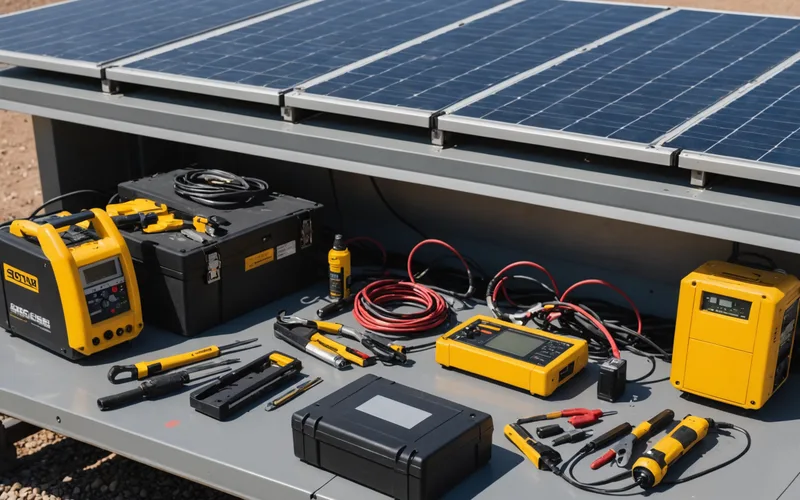
One to four days can pass after an alarm fires, often late in the day after peak generation, before a typical mid sized Brazilian solar plant is fully restored. A technician travels from the regional depot, diagnoses the issue on site, parts are ordered when necessary, and the system returns online. Until then, output stays below design levels. The revenue loss is real and routine.
This is reactive maintenance, not poor O&M. It is the industry's default when SCADA alarms and monthly performance reports are the main available signals. Predictive maintenance keeps the workflow but starts it earlier, before degradation becomes an alarm.
Reactive Maintenance Cost Structure
Predictive approaches become easier to value when reactive maintenance is split into three cost categories that O&M teams often combine.
Lost generation revenue. An inverter trip on a 5 MW block during peak afternoon hours can mean 15 to 25 MWh of lost output each day, depending on irradiance. At Brazilian utility scale PPA rates of R$280 to R$380/MWh, that equals R$4,200 to R$9,500 per day for each affected block. Parts delays can push a multi day outage into five figures.
Emergency response premium. An unplanned repair costs more than the same work during a scheduled visit. Mobilization, overtime when an alarm arrives outside business hours, expedited parts, and removing a technician from a planned route all raise the unit cost. For one technician covering plants across Bahia or Minas Gerais, an unplanned dispatch may cost 3 to 5 times a planned maintenance visit.
Secondary damage. Some faults worsen while they remain hidden. An inverter with one phase offline can continue in degraded mode, adding thermal stress to the other phases. Elevated contact resistance also produces progressive heating. Longer detection delays increase repair cost and the chance that equipment must be replaced instead of repaired.
Early Signals from Predictive Monitoring
Not every fault offers a useful early signal. Continuous telemetry is most effective when the degradation develops gradually and can be measured.
String performance drift. A string affected by a developing connection fault, partly degraded module, or bypass diode activation produces less output than peer strings under equal irradiance. The pattern often begins weeks before an open circuit event. Comparing 15-minute string current readings with an irradiance normalized baseline reveals the change. A string once within 2% of its cluster mean that now sits 6 to 8% below it warrants inspection before an alarm trips.
Inverter derating patterns. Thermal and grid related derating often appears in output data before a trip or alarm. If an inverter starts reducing output during peak hours on moderately warm days, unlike in earlier months, cooling system degradation or ambient temperature sensor drift may be developing. Its own diagnostics may still report it as healthy while 5 to 10% of peak performance is lost.
Clipping changes as a proxy for DC-side health. Clipping occurs when excess DC power meets the inverter's AC ceiling, so its duration is usually predictable from irradiance and the DC/AC ratio. A duration change without a matching irradiance change may point to module degradation, higher string resistance, or new shading on the array side.
Communication faults before hardware faults. SCADA streams from string inverters and combiners can reveal intermittent gaps before a hard failure. A combiner with 3 communication dropouts in a week, without a sustained alarm, may have a marginal power supply or a weakening communication interface. Reactive monitoring treats this as noise. Pattern aware monitoring treats it as a diagnostic signal.
The Scheduling Problem
Earlier warnings help only when the O&M team can act without adding new costs. For teams managing 10 to 30 MW across several sites, the task is both finding anomalies and scheduling the right response.
A failure signal detected 3 weeks ahead can be handled during the next planned site visit, removing the dispatch premium. A signal detected 3 days ahead may still call for an unplanned visit, but it can prevent secondary damage. A real time signal that arrives with the alarm offers no scheduling gain, though it gives the technician better diagnostic information before arrival.
The useful measure is not "how many faults did we predict?" It is "how many emergency dispatches became planned visits?" An illustrative 40% reduction in unplanned dispatches for a portfolio receiving 2 to 3 emergency calls per month can lower O&M costs and reduce revenue loss during multi day repairs.
Limits of Predictive Monitoring
The limits are clear. SCADA telemetry works well for gradual degradation that leaves electrical traces. It is less effective for sudden failures, external events such as lightning or flooding, and sensor or communications faults that occur before generation data is affected.
Drone thermography and site inspections remain important for cell level hotspots, delamination, and physical damage that may not create a consistent, distinguishable string level electrical signal. Analytics does not replace site visits. Continuous telemetry can reduce emergency visit frequency and improve preparation for visits that still take place.
The move from reactive to predictive happens in stages. Many O&M teams can begin by refining existing SCADA alarms, reducing noise and adding string level thresholds. Next comes continuous anomaly scoring against irradiance normalized baselines, followed by using those scores to schedule maintenance. Each stage cuts unplanned dispatches and helps teams act on early signals instead of alarms.
Starting Without a Major Infrastructure Change
Growing solar operators often tell us that predictive monitoring requires major infrastructure spending: new sensors, a historian database, and a dedicated data science team. In most cases, that concern is overstated.
Most Brazilian plants built after 2018 already communicate at inverter level through Modbus or SunSpec and log data to a SCADA historian at 5 or 15-minute intervals. String monitoring is less universal, though increasingly common in new installations. Much of the needed data is already collected. The missing layer is analysis that converts SCADA logs into irradiance normalized, plant aware anomaly scores a small O&M team can use without a data science background.
Solarvyew addresses that gap. We connect with existing SCADA sources, run continuous machine learning anomaly detection calibrated to each plant's irradiance environment and historical baseline, and surface signals useful for O&M scheduling. Instead of "inverter tripped," the alert can indicate "string cluster X is drifting, inspect on next site visit," giving the team time to plan rather than react.
For related context on the economic value of early detection, see our article on the ROI of early fault detection.